
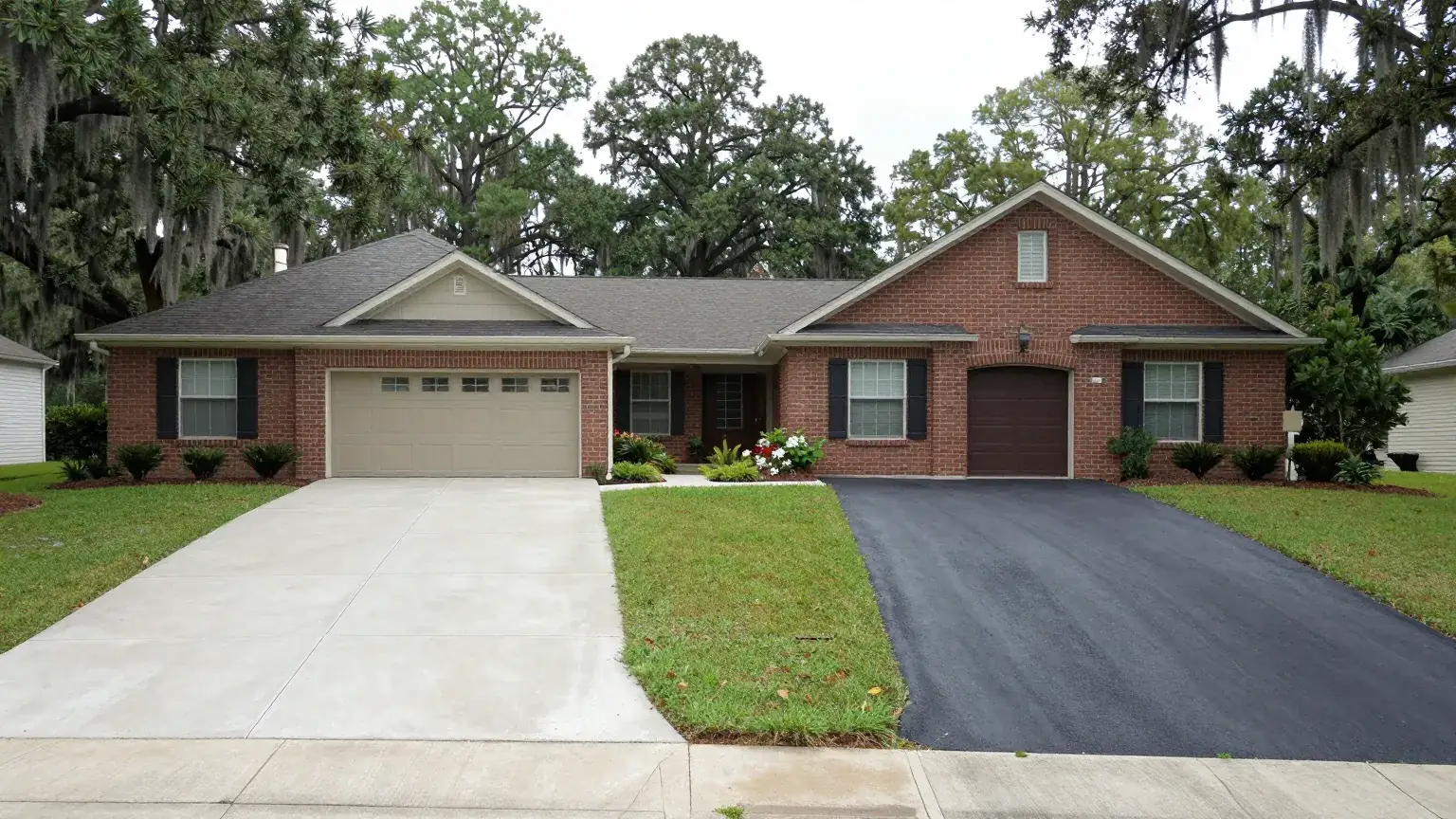
Up-front cost
An asphalt driveway nearly always costs less to install than a concrete one of the same size, often a good deal less, and it goes in faster: a typical home driveway is paved in a day and can be driven on within a few days, while concrete needs forms, reinforcement and a week or more of curing. If the budget is the deciding factor, asphalt usually wins. The asphalt driveway cost guide shows the asphalt line items.
Lifespan and upkeep
A well-built concrete driveway can outlast asphalt by a wide margin and needs very little routine care. Asphalt commonly lasts 15 to 20 years here and asks for crack sealing and a sealcoat every few years to get there. So concrete costs more at the start and less along the way, while asphalt costs less at the start and a little every few years.
Heat, heavy rain and clay soil
This is where the local ground matters. Much of the Baton Rouge area sits on clay that swells in wet months and shrinks in dry spells. Asphalt is flexible and moves with the ground to a degree; when it does crack, the crack can be sealed or the area patched. Concrete is rigid, so ground movement shows up as cracks across slabs or one slab settling below the next, and those are harder to fix without breaking out a whole section. In the summer heat, asphalt can scuff under turning tires when it is new, while concrete stays cooler underfoot. Both need to drain well; neither survives standing water over a soft base for long.
Call (225) 338-4482 Request a callback
Repairs and resurfacing
Asphalt is easier to repair invisibly. A failed area can be cut out and patched with hot-mix, and when the whole surface is tired, a new layer can go over the top. Concrete repairs usually mean saw-cutting and replacing whole slabs, and patched concrete rarely matches. Over a 20-year span, that difference in repair cost narrows the gap between the two.
Which one fits your driveway
For most Baton Rouge homes with a typical two-car driveway on a flat lot, we would pick asphalt for the lower cost and easier repairs, with good drainage and a solid base. Concrete makes sense where heavy point loads sit for long periods, such as a camper or boat on its tongue jack, or where a homeowner wants to do almost no upkeep and the budget allows. Long country drives are often better served by tar and chip. If you want asphalt, see driveway paving.